4 Jul 2026
Micro casks come in a range of standardized sizes that suit home use and small-scale production. Understanding these measurements helps users select the right vessel for aging spirits, vinegar, or other liquids without excess waste or inefficient space use.
Common Volume Capacities
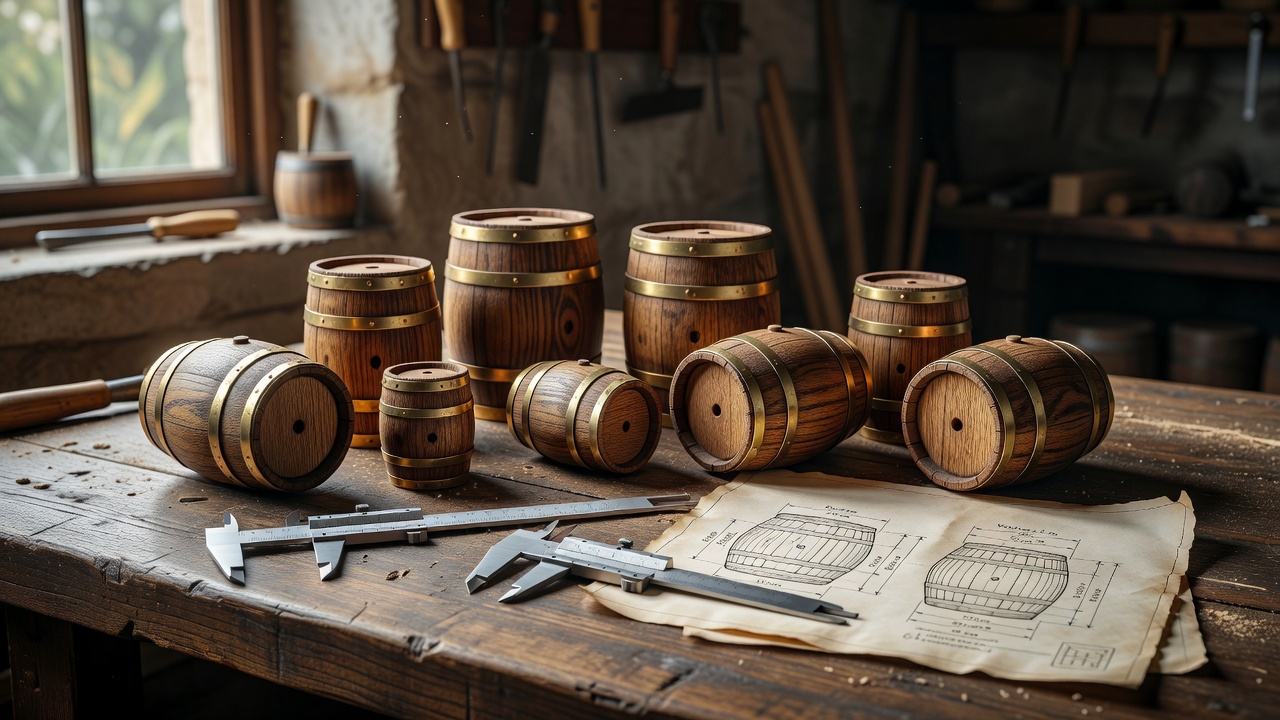
Typical micro cask volumes include 1 liter, 2 liters, 5 liters, and 10 liters. A 1-liter cask holds enough liquid for personal tasting batches while minimizing evaporation loss. The 2-liter size offers a balance between quantity and surface-area contact, often used for initial flavor experiments. Larger 5-liter and 10-liter options provide greater capacity for repeated refills, with the 5-liter model commonly chosen for consistent small-batch aging over several months.
Volume selection also depends on the intended aging period. Smaller capacities accelerate flavor extraction due to higher wood-to-liquid ratios, while volumes above 5 liters slow the process and require more monitoring of alcohol strength and temperature.
Physical Dimensions and Weight
Dimensions vary by volume. A standard 1-liter cask measures approximately 15 cm in height and 12 cm in diameter, weighing 0.8 kg when empty. The 5-liter model reaches 25 cm tall with a 20 cm diameter and weighs about 2.5 kg empty. These sizes fit most home shelves or small storage areas, and the compact footprint allows stacking on standard racks without specialized equipment.
Empty weights range from 0.5 kg for the smallest units to 4 kg for 10-liter versions. Filled weights increase by roughly 1 kg per liter, so users must account for shelf load limits when planning storage arrangements.
Usage Ratios and Practical Numbers
Surface-area-to-volume ratios decrease as capacity grows. A 1-liter cask presents roughly 0.08 m² of internal wood surface per liter, promoting faster interaction with the liquid. In contrast, a 10-liter cask offers about 0.03 m² per liter, resulting in slower maturation suitable for longer storage. Evaporation rates average 2–4% per month in smaller casks and drop below 2% in larger ones under controlled humidity.
These figures guide decisions on batch size, refill frequency, and expected yield. Selecting a cask with appropriate numbers ensures efficient use of space, wood, and liquid while delivering predictable results over time.